
How Much Schach Do You Need? A Coverage Guide by Sukkah Size (8×10, 10×12, 10×16 and More)
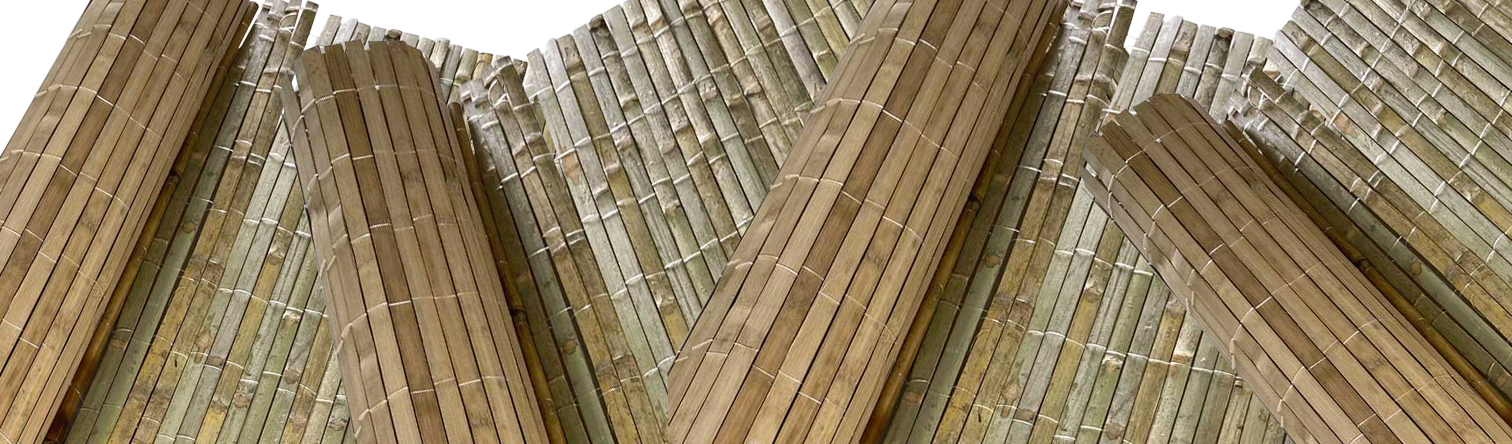
Every year around Elul, the phone starts ringing with some version of the same question: “How much schach do I need?” Usually the caller has a sukkah frame in the garage, a tape measure in hand, and a vague memory of coming up short last year. It’s a good question, and the answer is more straightforward than most people expect—once you know the one measurement that actually matters (hint: it isn’t square footage alone).
Below is a plain-English coverage guide: the math, the sizes, the combinations that work for the most common sukkah dimensions, and the ordering mistake we spend every September helping people avoid.
The Short Answer: Cover the Whole Roof
Halachically, a sukkah needs more shade than sun—the shaded area created by the schach must exceed the sunlit area, and no single gap of open sky should run three tefachim (roughly 9 to 12 inches) or more across. In theory, that means you could get away with covering a little over half your roof.
In practice, nobody builds that way, and you shouldn’t either. Sparse schach means hot spots at lunch, gaps that widen when the wind picks up, and a roof that doesn’t feel like a roof. Plan on covering 100% of your roof area. Buy for full coverage, and the halachic minimum takes care of itself with room to spare. (If you want the full rundown on walls, height, and dimensions, see our guide to the minimum requirements for a sukkah.)
Start With Roof Area—Then Check the Direction
Step one is easy: multiply length by width. An 8x10 sukkah has 80 square feet of roof. A 10x12 has 120. A 10x16 has 160.
Step two is the one people skip. Bamboo schach mats are directional. A mat described as “6 feet wide, rolls out to 12 feet” is made of individual bamboo slats roughly six feet long, woven side by side along a twelve-foot run. Those slats have to lie across your roof support bars, not parallel to them. If the slats run the same direction as the supports, half of them are resting on nothing but air—and the mat sags, bows, and eventually dips into your soup.
This is why a 4x12 mat and a 12x4 mat are not the same product. Our own 4x12 mat listing carries a warning in bold: if you’re covering an 8x12 sukkah, don’t order 4x12 mats—order two 6x8 mats instead, so the slats run the correct direction over the supports. Same square footage, completely different result.
So the real formula is:
- Roof area = length × width.
- Slat direction = perpendicular to your roof support bars.
- Mat combination = mats whose slat lengths add up to one dimension, and whose roll-out length matches the other.
Coverage Guide by Sukkah Size
Here’s what the numbers look like for the sizes we’re asked about most. Combinations below assume standard bamboo mats in our common sizes (4x8, 6x8, 5x10, 4x12, 6x12).
- 8x8 (64 sq. ft.): Two 4x8 mats. This is the exact combination we spec for our 8x8 kits, including the EZ-Store version.
- 8x10 (80 sq. ft.): One 6x8 mat plus one 4x8 mat—slat lengths add to 10 feet, each rolling out across the 8-foot span.
- 8x12 (96 sq. ft.): Two 6x8 mats. Do not substitute two 4x12s, even though the square footage matches.
- 10x10 (100 sq. ft.): Two 5x10 mats. Clean, symmetrical, no trimming.
- 10x12 (120 sq. ft.): One 6x12 plus one 4x12 (or the equivalent pair running the other direction, depending on your frame).
- 10x16 (160 sq. ft.): Plan on four mats in the 40-square-foot range—commonly a mix of 6-foot and 4-foot widths rolled across the 10-foot span.
- 12x16 (192 sq. ft.): Four 6x8 mats, laid two across and two deep. One of the tidiest big-sukkah layouts there is.
- 16x20 and up (320+ sq. ft.): At this scale, mat layout depends entirely on how your roof bars are spanned. Give us a call and we’ll lay it out for you—this is what we do all day in September.
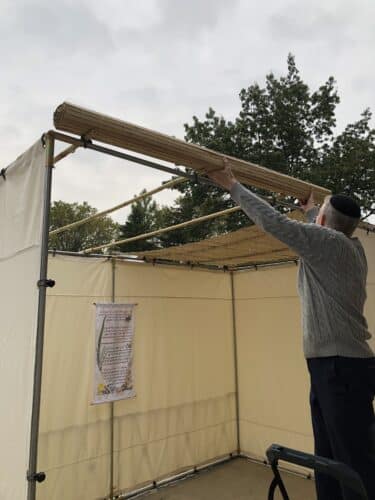
Two notes on the list above. First, a couple of feet of overhang past a wall is harmless, but only the area over the enclosed footprint counts as your sukkah—schach hanging out past the walls doesn’t extend the room. Second, if you’re covering one of our kits, the correct mats are already listed on the kit’s product page. You don’t have to do this math at all.
How Much Schach If You’re Using Loose Bamboo Poles?
Mats are the easy path, but plenty of people prefer loose bamboo poles or reed bundles. The math changes because you’re now counting pieces instead of coverage.
A good working rule: lay poles about every 3 to 4 inches along the run. That gives you comfortable shade with the pleasant dappled light people love, without leaving gaps anywhere near the three-tefach limit. For a 12-foot run, that’s roughly 36 to 48 poles. For a 16-foot run, figure 48 to 64. Order about 10% extra—poles split, and you’ll want spares in year three.
If you’re using evergreen branches or bamboo brush, forget counting entirely and go by eye: stand inside at midday and look up. If you see more shade than sun and no window of sky wider than your hand span, you’re there. Then add a little more, because greens shrink and settle over the week.
Three Mistakes That Cost People a Second Order
- Measuring the frame instead of the opening. Measure the actual roof area your schach has to span, including any lip the mats will rest on. Round up, never down.
- Forgetting the supports. Schach mats need something to rest on every few feet. If your frame has bars only around the perimeter, a 10- or 12-foot span will sag. Add crossbars—and if you’re wondering what those bars can be made of, we covered it in Can Schach Rest on Plastic?
- Buying by square footage alone. Worth repeating: 4x12 and 12x4 cover identical area and behave completely differently on your roof.
Star-K, Mehadrin, and What You’re Actually Buying
Once you know how much you need, the remaining question is which mats. Ours are woven from premium natural bamboo and come in two certifications: Star-K mats, which use a thin monofilament thread binding, and Mehadrin mats, which are bound with natural raffia for those who prefer schach with no non-plant material at all. Both are certified kosher; both roll up for storage and come back out year after year. Stored dry and out of direct sun, a good mat lasts many seasons—which is what makes the per-year cost so reasonable.
If mats are new to you, our explainer on what a schach mat is walks through how they’re made and why they became the standard for home sukkahs. And if you’re still choosing a frame, start with our beginner kit guide or the broader guide to buying a sukkah online—the frame determines the mat layout, so it’s worth settling that first.
Order Early, Measure Twice
Schach is the one component you can’t improvise the night before. Frames wait patiently in the garage; mats have to ship. Check when Sukkot falls this year, work backward a few weeks, and get your order in before the September rush.
And if you’re staring at an odd-shaped roof, a six-sided sukkah, or a custom build and the numbers above don’t quite fit—just call. Tell us your dimensions and which way your roof bars run, and we’ll tell you exactly which mats to order. Thirty years in, there aren’t many roofs we haven’t covered.

3 Responses